

PUBLICATIONS

(Forthcoming; McFarland, 2026)
How can illustrations from play experiences and pop-culture clarify the complicated theological approaches for being interreligious? This book brings the Bible into conversation with insights from anime, comic books/graphic novels, movies, and video games. Picturing its approach as a video game controller, this book shows how people can follow the directions of their spirituality with structures of reason (like a D-Pad) while also engaging different ideas and differing people with new and creative patterns (like action buttons).

“Final FantaSi’ VII: Role-Playing the Eco-Ethics of Laudato Si’” in The World of Final Fantasy VII: Essays on the Game and its Legacy (McFarland, 2023)
This chapter explains how Final Fantasy VII role-plays Laudato Si’s eco-ethic in cognitive, social, and emotional, and motivational dimensions.

(Religions, 2022)
Modern religious plurality invites religious and non-religious people to navigate four interreligious dialogical problems: (1) the inability to fully articulate faith, (2) the lack of persuasive religious language, (3) the reality of violence among the religions, and (4) the liquescent “truth” of modern times. How can plurality be framed for people whose sense of relationality is shaped by their participation in virtual worlds? One answer emerges in this autoethnographic consideration of how video gaming “plays out” fresh understandings of the interreligious encounter and relationality.

“Sabbath-Keeping is Child’s Play: Exploring The Symbiosis of Play and the Sabbath,” Pittsburgh Theological Journal. Autumn 2018: 111-136.
This research article considers the encouraging connections between play and Sabbath experiences for the benefit of those seeking alternatives to culturally-mandated overwork and overindulgence inside and outside of church buildings.

“There Can Only Be One: Canaanite Influences On Psalm 82,” Pittsburgh Theological Journal. Autumn 2017: 75-94.
Despite the variety of approaches toward Psalm 82, scholars reach similar conclusions about its theological content and liturgical purpose. God's presence in liturgical, cultic, and cultural contexts reveal all competitors as incompetent, mortal, and false caricatures. There can only be one true God amidst many pretenders.
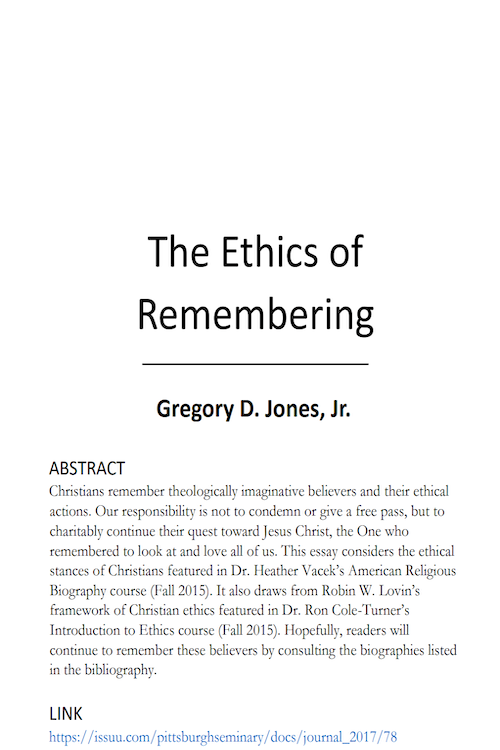
“The Ethics of Remembering,” Pittsburgh Theological Journal. Spring 2016: 78-92.
Christians remember theologically imaginative behaviors and their ethical actions. Our responsibility is not to condemn or give a free pass, but to charitably continue their quest toward Jesus Christ, the One who remembered to look at and love all of us. This essay considers the ethical stances of notable Christians, and draws from Robin W. Lovin's framework of Christian ethics. Hopefully, readers will continue to remember these believers by consulting the biographies listed in the bibliography.

“Embracing the Mystery of the Divine,” Pittsburgh Theological Journal. Spring 2015: 10-21.
This article considers a common thread found among C.S. Lewis's books (The Magician's Nephew, Till We Have Faces, The Pilgrim's Regress): how experiences of mysterium tremendum et fascinans redirect human suffering, longing, and complaint into a deeper understanding of the inscrutable, yet trustworthy God.