

PRESENTATIONS

27. Grefenstette Center for Ethics National Research Scholars Roundtable 2026, Pittsburgh, PA
Insights from theology, media studies, and pop-culture explain how virtual world platforms cultivate "Play-I" (human awareness; humane interaction) for using technology to tell our human stories, and not just the information of technology that is more extractive than it is either artificial or intelligent.
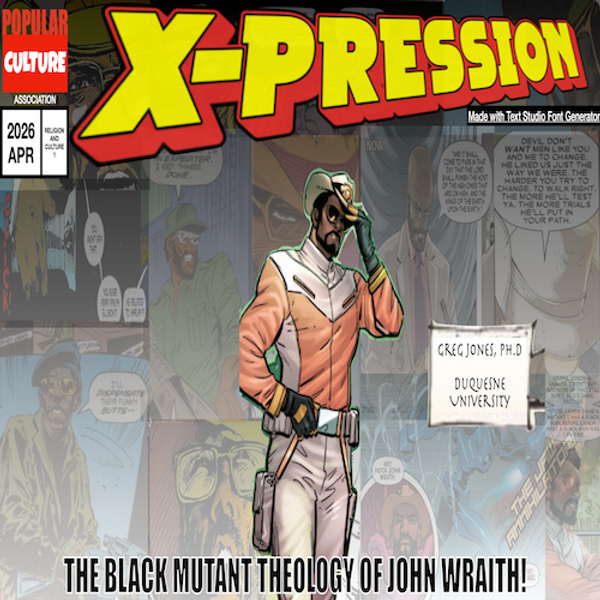
26. Pop-Culture Assocation 2026, Atlanta, GA
The obscure John Wraith expresses (X-presses) a similarly obscure vantage point within the notably diverse X-Men: the black theological presence. Wraith’s obscurity and untouchability also frames how his words and his actions offer black theological commentary on mutant culture. Each facet of John Wraith illustrates the concept of X-pression: how X-Men comics provide a creative canvas to meaningfully illustrate black theology and other contextual perspectives.

25. SWPACA 2026, Albuquerque, NM
Could the triangle, square, cross, and circle action buttons of the Sony PlayStation controller be a pop-culture symbol for a unified spiritual and theological framework for interpreting reality? This paper explains how pressing each button symbolically “plays out” a particular response to a media environment, by combining the dimensions of play theology with symbols that express the meanings of key insights from several religions (mainly focusing on Christianity and Shinto). The unification of these media responses collectively constitute Play-I, the play theology-based approach to navigating modern media environments.

24. MAPACA 2025, Philadelphia, PA - Crash Course Session
Jesus's Matthew 22:21 teaching frames a practical and doable schedule of "data balkanization" that prevents having your data belonging in one place, to one company, to do with what they please. Significance: Taking back our digital data from Big Tech is something everyone can do, as an act of protest, self-preservation, and resistance against the powers of the anti-democracy oligarchy.

23. MAPACA 2025, Philadelphia, PA
What can we learn by placing the Krakoa Age’s depictions of mutant authority, human power, and machine dominion into conversation with the Christian expression of power as exousia – the New Testament Greek word that expresses God’s power as the leading and the influence that is expressed in the Person of Jesus and the Presence of the Holy Spirit? Krakoan exousia, or X-ousia, gives us a comic book playground for creatively clarifying, appreciating, and unifying the Christian theological expressions of God’s power (Romans 8:18-30).

22. PCA/ACA Conference 2025, New Orleans, LA
How can Krakoa’s comic-book ending be understood in conversation with the ending stories of several world religions? I answer, Krakoan eschatology – or X-chatology – is a comic book space for thinking about and talking out the religious conceptions of the end times with humanly accessible and relatable sensibilities. This article interprets the entire “Fall of the House of X/Rise of the Powers of X” story arc as an eschatological narrative.
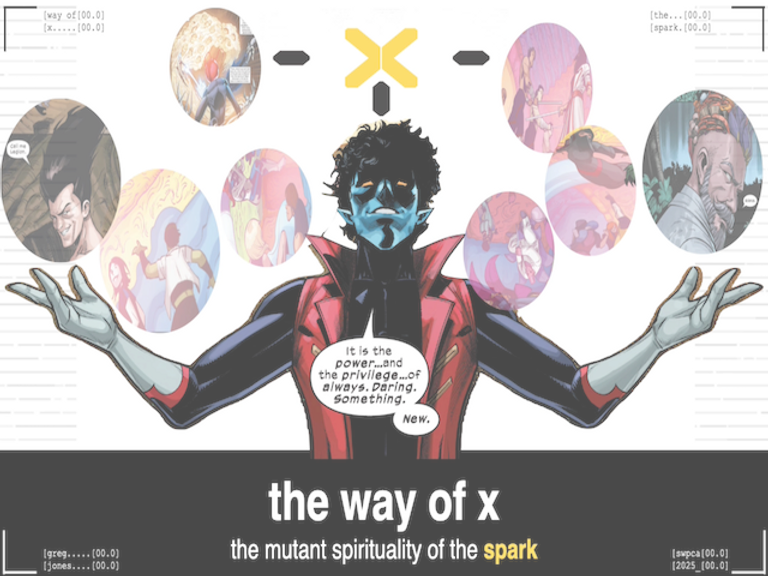
21. SWPACA 2025, Albuquerque, NM
During the Krakoan Era of X-Men comics, the Way of X series (which culminated in the one-shot X-Men: The Onslaught Revelation) saw the mutant of faith known as Nightcrawler envision a mutant spirituality called “The Spark.” He describes it in a profound quote – “it is the power…and the privilege… of always. Daring. Something. New.” In my paper, I explore how The Spark is a comic book experiencing of a religion’s function to identify the human predicament, develop the solution to that problem, cultivate techniques for achieving the goal, and spotlight exemplars who walk the path to the goal.

20. MAPACA 2024, Atlantic City, NJ
The current growth in secular, philosophical, and scientific interest in the concept of the multiverse provides a convenient opportunity to solidify Christianity’s potential theological commentary on the existence of multiple universes. Does Christianity address the problem of sin and the promise of redemption on a multiversal scale? I answer this question by considering how The Shift and The Cusanus Game adopt different portrayals of the multiverse as an obstacle course that gets continually complicated by the myriad of human choices, yet is ultimately secure in God’s grasp.

19. PCA/ACA 2024, Chicago, IL
X-Men (2021) #12 features the revelation to the wider Marvel Universe that “mutantdom has solved for death.” An excerpt from Ben Urich’s Daily Bugle article insists “the implications for life on this planet are staggering. In the days to come, we’ll be discussing the matter with scientists and theologians.” I ask, how is Krakoa’s comic-book resurrection understood in conversation with Christian depictions of immortality? I answer, Krakoan resurrection is the mutant metaphor which adapts religious conceptions of immortality into the comic book medium for audiences to explore and reconsider with human sensibilities.

18. Southwest Commission on Religious Studies Annual Conference 2024, Irving, TX
This paper makes four moves to explain how a play theology of religion holds different religions lightly as “conspirators.” The first move frames Paul’s “And Move” as the Christian way of “breathing with” other belief systems; the second move (as if-ing) begins this repurposing; the third move (what is-ing) humanizes this container as a room of finite relationality; the fourth move (what could be-ing) multidimensionalizes this room as a play vista unfolding in all directions. This conspirational orthodoxy is the belief system of “conspirators” who follow the Holy Spirit “breathing where [s/he] will” across the ever-unfolding play-vista of interreligious relationality.

17. SWPACA 2024, Albuquerque, NM
This presentation describes interreligiosity in role-playing game (RPG) terms, describing its 1) field of play (following how Courtney Goto and Lakisha Lockhart envision the playful container for holding people lightly in youth ministry), 2) human obstacles (following Juan Segundo’s commitment to social and material limits in liberation theology), and 3) multiple dimensions (following Roger Caillois’s four dimensions of play experience). These moves set the stage for describing interreligiosity in play terms: navigating the obstacles and boundaries of a shared relationality with finitely distributable relational energy, whose function is comparable to the limited hit points (HP) and magic/mana points (MP) operative in role-playing games (RPGs).

16. MAPACA 2023, Philadelphia, PA
Can the design of the Sony PlayStation controller and playful activity of pushing its buttons clarify how a Christian theology of religions can navigate and sustain interreligious relationality? My paper answers this question by envisioning "contestant theology" as a pulling-at and a moving-with other religions, according to the wind of the Spirit, as a theological video game controller that plays through the dialogical problems in the interreligious encounter.

15. PCA/ACA 2023, San Antonio, TX
How can a Christian theology of religions navigate the dialogical problems of the interreligious encounter? My paper answers this question with “contestant theology” – a Christian play theology of religions based upon the insights of play theology and popular culture. This paper engages the “And Have Our Being” of Paul’s exclamation by considering how the multidirectional and multidimensional aesthetic of the Christian cross grounds specific practices in which Christians can crossover with different religions and collide with differing people in the sharing of God’s ungraspability.

14. SWPACA 2023, Albuquerque, NM
Studying the writings of several Patristic and Medieval theologians, this paper uses Kate Bush's song "Somewhere in Between" to structure interrelated articulations of the way of life that outplays sin and death. This "law of the Spirit" is the God-gifted game of the perpetual enjoyment of, oneness with, eternal progress in, wholeness through, and holiness like God.

13. MAPACA 2022 Annual Conference
This presentation follows the first movement of Paul’s Acts 17:28 speech (“in God”) by using a religious experience found in the video game Xenogears, which features a memorable scene involving a sculpture of two single-winged angels reaching for each other in a depiction of interreligious relationality.

12. MPCA 2022 Annual Conference
This presentation covers a portion of my dissertation, which is organized around Paul's Acts 17:28 inter religious preaching of Christ to the Areopagus, "‘For in him we live and move and have our being.’ As some of your own poets have said, ‘We are his offspring.’" This paper describes a way to navigate the interreligious encounter with Goku-like playful and skillful movements that live out and live beyond the limits of one’s religion.

11. PCA/ACA Conference 2022
How can a Christian theology of religions navigate the dialogical problems of the interreligious encounter? This presentation summarizes how my dissertation answers this question with “contestant theology” – a Christian play theology of religions based upon the insights of play theology and popular culture.

10. FWPACA 2022
Some scholars discuss Revelation as picture, theater, and cinema. This paper draws from the phenomenological conscious experience of the cubic paradigm and medieval exegesis of Scripture to view Revelation through the lens of playing the video game Super Mario 64.

9. MAPACA 2021
The thesis of this paper states that the gaming experience of The S3 Plan enables gamers to genuinely acknowledge how we are manipulated into serving certain causes and ideologies. In response to this realization, we can more intentionally and fervently look beyond the data that is fed to us, develop our own visions with responsibility, and pass these genuine beliefs on to others.

8. MPCA 2021
This paper offers a modern answer to this question; it describes how the Metal Gear Solid video games “play out” divergent ways to change the world through its three principal characters. After ethical and theological evaluations of these approaches, the conclusion insists that the Metal Gear Solid games teach us the value of “leaving the world as it is” – learning to be who God created us to be and granting others the space, time, and friendship for discovering and embracing God’s design of wholeness and holiness.

7. PCAS 2021
This paper answers this question by considering how retrogame experiences bring Sabbath reality into everyday life. The conclusion provides the definition of “retrogame theology” as a three-part framework of understanding the theological value of retrogames that 1) acknowledges a modern yearning for God’s presence beyond institutional contexts, 2) affirms that God meets us in Sabbath experiences within the midst of our real lives, and 3) plays out our awareness of these Sabbath experiences in retrogaming, which is necessarily irrelevant and irreverent, in order to unearth us from our routine programming to overwork and overindulge.

6. PCA/ACA Conference 2021
Video gaming “plays out” a new understanding of the theology of religions, particularly through games such as Spiritual Warfare for the NES (honest exclusivism), Final Fantasy VI for the SNES (compassionate inclusivism), Final Fantasy X (open pluralism), and Journey (harmonic trinitarianism). These games also help us to bring together enrichment and diminishment in an expansive relationality. When we adopt the contestant perspective, we overcome the academic problems of dialogue in the interreligious encounter.

5. SWPACA 2021
This article shows how video gaming allows gamers to “play out” the Enoch narrative. The first section briefly summarizes how the Books of Enoch are the literary playing out of theophanic experience. The following sections describe how Enoch functions as a player and playground that provides narrative and conceptual language for early Christian exegesis and polemics. The next section connects these early theophanic portrayals to modern ways in which several video games play out Enochic themes. The conclusion insists that video gaming the Enoch narrative can express Christian faith in an era where Christian experience outside of institutions, and in surprising contexts, remains valid, if not increasingly desired.

4. FWPACA 2021
Examining the claims of the Foucauldian discursive approach adherents and objectors, this paper considers how Final Fantasy VI provides a conversational meeting ground for the two groups by playing out 1) friendships that cross moral aisles, 2) experiences of divided identity and loss, and 3) human connectivity in the midst of clown-nihilism.

3. MPCA 2020
This paper explains how video gaming “plays out” the participatory theophanic themes of the Enoch narrative in ways that can be appreciated in the context of routine life, inside and outside of institutional Christianity.

2. FWPCA 2020
How does pop-culture confront the moral oddness that subjects John Rawls’s theory of justice to shifting societal convictions? The ethitainment ethical framework 1) displays the influence of social narratives (A Time to Kill), 2) plays out the quandary they cultivate (Metal Gear Solid), 3) illustrates the need to act beyond moral oddness (Batman: The Killing Joke), and 4) portrays sovereign authors of moral meanings who avoid instrumentalizing humanity (Ocean’s Thirteen).

1. MAPACA 2019
In light of its upcoming remake for a new generation of gamers, this paper offers a timely consideration of how the original FFVII role-plays LS’s eco-ethic in cognitive, social, emotional, and motivational dimensions.